From Detection to Decision: How Kenya is Transforming Public Health Emergency Response with Artificial Intelligence

Kenya and the Future of Global Health Security: Balancing Sovereignty, Preparedness, and Solidarity in the Wake of the Ebola Outbreak
May 29, 2026
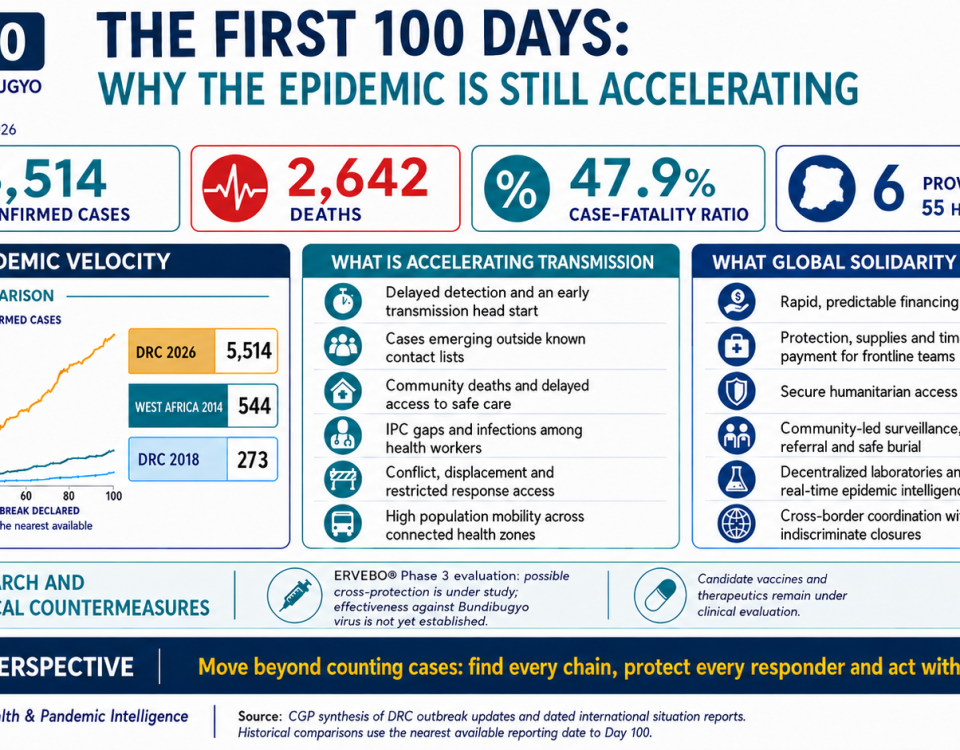
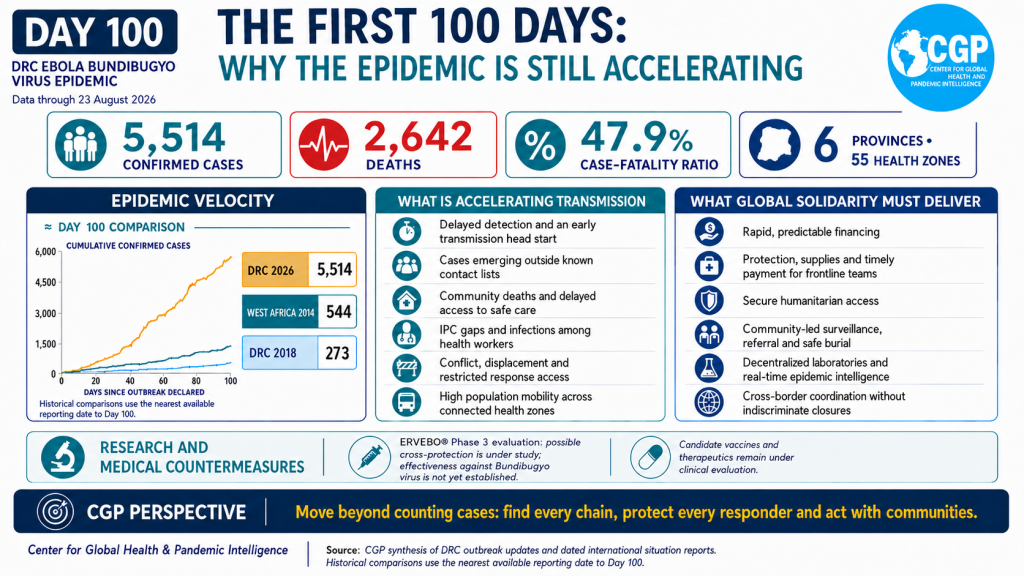
The First 100 Days: Why the DRC Ebola Epidemic is still accelerating
August 26, 2026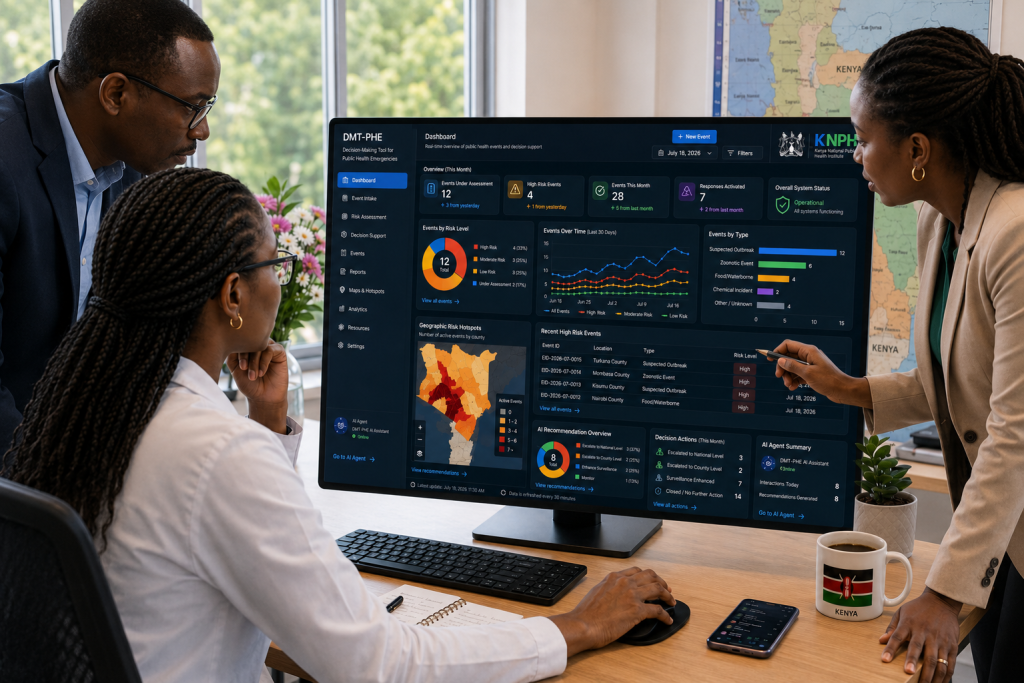
CGP Media | Nairobi-Kenya| July 21 2026- 18:00 EAT
A collaboration between Kenya National Public Health Institute (KNPHI), Palladium, Center for Global Health and Pandemic Intelligence (CGP), Washington State University (WSU), University of Michigan, Center for Global Health Equity( UM CGHE), and Kenya Institute for Primate Research (KIPRE) is demonstrating how artificial intelligence can support faster, more consistent decision-making during public health emergencies from Ebola outbreaks to emerging health threats.
Imagine a health worker in a Kenyan border county noticing several people with unusual bleeding symptoms. Community health promoters alert local health officials, and the first discussions begin informally through phone calls and WhatsApp messages. It takes two days before the information is formally documented and shared with the county health office. Another day passes as officials determine whether the event is serious enough to notify national authorities. At that point, laboratory confirmation is still pending and clinical information remains incomplete, yet critical decisions must still be made. By the time a response team is deployed, similar cases have already been reported in a neighbouring area.
The challenge is not that no one noticed the warning signs. The challenge is that early signals did not move quickly enough into clear decisions and coordinated action. During infectious disease outbreaks, those first hours and days can determine whether an event is rapidly contained or develops into a much larger public health emergency. While advances in surveillance systems have improved countries’ ability to detect public health threats, translating those early warning signals into timely and consistent decisions remains one of the most persistent challenges in outbreak response.
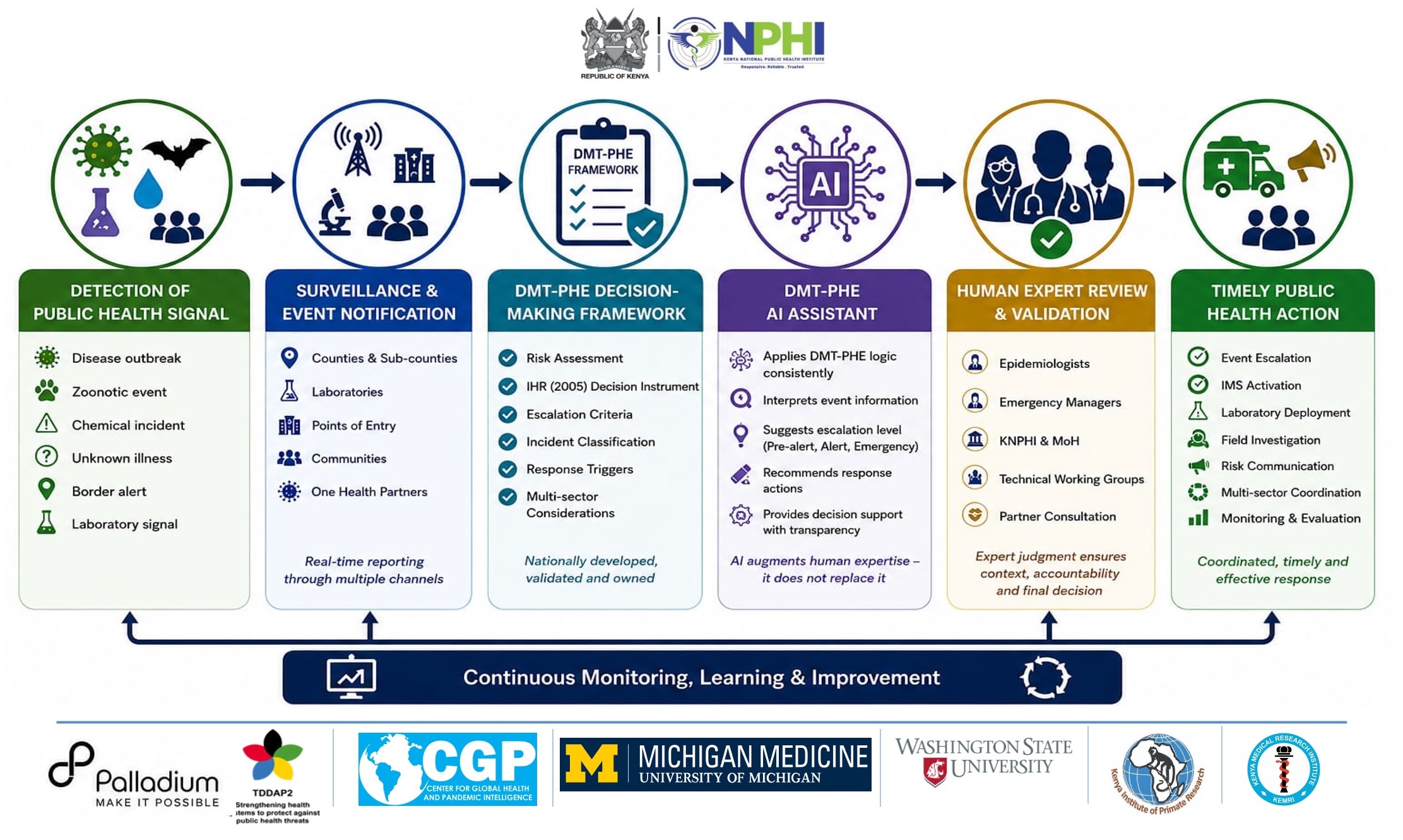
In Kenya, a collaborative effort led by the Kenya National Public Health Institute (KNPHI), Palladium’s Tackling Deadly Diseases in Africa (TDDAP2) Programme, funded by the UK’s Foreign, Commonwealth & Development Office (FCDO), and the Center for Global Health and Pandemic Intelligence (CGP) has sought to address this challenge. Together, these institutions developed the Decision-Making Tool for Public Health Emergencies (DMT-PHE), a structured framework designed to strengthen the assessment, escalation, and management of public health events. To accelerate the translation of DMT-PHE into decisions for outbreak response, additional partners including Washington State University (WSU), the University of Michigan’s Center for Global Health Equity (CGHE), and the Kenya Institute of Primate Research (KIPRE) joined efforts to support the digitization, artificial intelligence development, evaluation, and future advancement of the platform. Collectively, these institutions are helping transform a nationally developed decision-making framework into an innovative AI-assisted system for strengthening public health emergency response..
Building a Foundation for Better Decisions
The journey began with a simple but important question: How can public health professionals make faster, more consistent, and more evidence-based decisions during emergencies?
According to Dr. Mark Nanyingi an infectious Disease Epidemiologist of CGP and a Global Health Affiliate Member at the University of Michigan Center for Global Health Equity (CGHE), who led the technical development of the Decision-Making Tool for Public Health Emergencies (DMT-PHE), the answer lay in transforming complex guidance into practical action.
“Public health guidance existed, but decision-makers lacked a practical tool to consistently translate surveillance information into timely action. Our goal was to convert complex emergency management principles into a simple, operational framework that could be applied across any public health emergency” said Dr. Nanyingi
Developed through the TDDAP2 programme in support of KNPHI, the DMT-PHE was conceived as a nationally owned framework to guide the assessment, escalation, notification, and management of public health events. Drawing upon the International Health Regulations (2005), public health emergency management principles, incident management systems (IMS), and Kenya’s preparedness architecture, the framework provides a structured process for evaluating events and determining appropriate response actions.
What distinguishes the DMT-PHE is its ability to translate complex technical guidance into a practical decision-making pathway that can be used by public health professionals operating at national and subnational levels. Rather than relying solely on individual interpretation, the framework provides clear criteria for assessing risks, escalating events, activating response mechanisms, and coordinating actions across multiple sectors.
For Dr. Kadondi Kasera (Palladium), who led the TDDAP2 programme team supporting KNPHI throughout the development process, the DMT-PHE represented an opportunity to strengthen one of the most critical links in outbreak response.
“Preparedness is not only about detecting threats—it is about ensuring institutions can act quickly and confidently when they emerge. The DMT-PHE helps transform information into coordinated action across the health system” said Dr. Kasera.
The framework underwent extensive stakeholder consultations, technical reviews, simulation exercises, and national validation workshops involving epidemiologists, emergency preparedness specialists, laboratory experts, risk communication practitioners, and public health managers from across Kenya. Through these processes, the DMT-PHE was refined and tested using realistic scenarios reflecting some of the country’s most significant public health threats, including viral haemorrhagic fevers, zoonotic outbreaks, cholera outbreaks, chemical incidents, and public health events of unknown etiology.
A National Framework for Health Security and Digital Decision Support
For KNPHI, the initiative represented an important step toward strengthening national preparedness and response capacity.
“Detecting a public health threat is only the first step. Equally important is knowing when and how to act. The DMT-PHE provides Kenya with a nationally owned framework for making timely, coordinated, and consistent decisions during public health emergencies.” said Dr. Kamene Kimenye, Acting Director General of KNPHI.
As the framework matured, the development team began exploring how digital technology could further enhance its utility. Because the DMT-PHE had already translated expert public health guidance into a standardized, transparent, and operational decision pathway, it provided an ideal foundation for digitization and, ultimately, artificial intelligence. Unlike many public health processes that rely heavily on individual expertise and interpretation, the framework had already codified key decision points into a structured process that could be applied consistently across different public health emergencies.
For Dr. Isaac Ngere, Medical Epidemiologist of Washington State University Global Health- Kenya, this presented an opportunity to move beyond traditional paper-based guidance and create a more dynamic system capable of supporting users in real time.
“The DMT-PHE already contained the decision logic. Digitization allowed us to make that logic accessible, scalable, and available in real time—transforming a static framework into an interactive decision-support system” said Dr. Ngere.
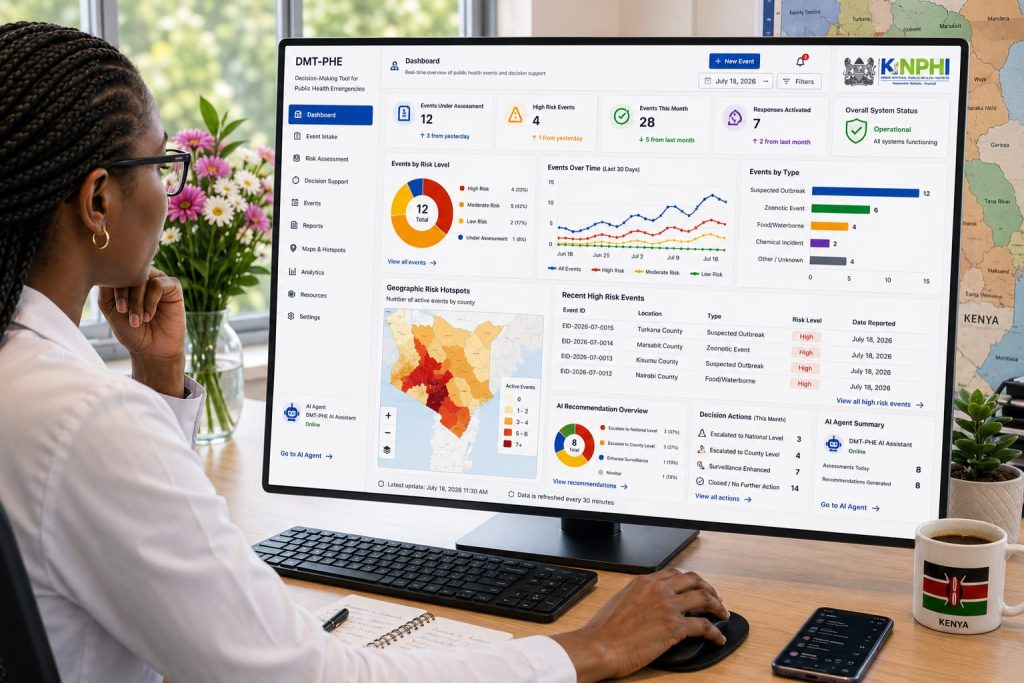
The digitization of the DMT-PHE laid the groundwork for an even more ambitious innovation. Recognizing the potential of artificial intelligence to support public health decision-making, Dr. Geoffrey H. Siwo, AI Lead at the University of Michigan CGHE and Research Assistant Professor with joint-appointment in the Departments of Learning Health Sciences and Pharmacology spearheaded the development of the DMT-PHE AI Agent. The platform was designed to translate the nationally validated DMT-PHE framework into an interactive AI-enabled system capable of assisting public health professionals in interpreting outbreak information, applying escalation logic, and recommending response pathways. Rather than replacing expert judgment, the AI Agent was conceived as a digital companion that could help decision-makers apply established public health emergency management principles rapidly, consistently, and transparently during evolving emergency situations.
Putting Artificial Intelligence to the Test
The emergence of artificial intelligence in public health has generated both excitement and caution. While AI has demonstrated considerable potential in data analysis and prediction, questions remain regarding its reliability, transparency, and operational applicability. Recognizing these concerns, the consortium prioritized a rigorous evaluation of the DMT-PHE AI Agent before considering broader implementation.
Using realistic public health emergency scenarios encompassing directly transmitted infectious diseases, zoonotic outbreaks, and public health events of unknown origin, the consortium conducted a pilot evaluation to determine whether the AI Agent could accurately and consistently apply the nationally validated DMT-PHE framework. Recommendations generated by the AI Agent were systematically compared with independent assessments performed by public health experts using the same framework. The evaluation demonstrated a high degree of agreement between expert assessments and AI-generated recommendations, providing encouraging evidence that the system could reliably support public health emergency assessment, escalation, and response across a range of outbreak scenarios.
The findings from the AI Agent’s development and pilot evaluation are available in a preprint manuscript, Development and Evaluation of an Artificial Intelligence–Assisted Decision Support System for Public Health Emergency Classification and Escalation in Kenya, which provides detailed methods, evaluation results, usability findings, and implications for future implementation
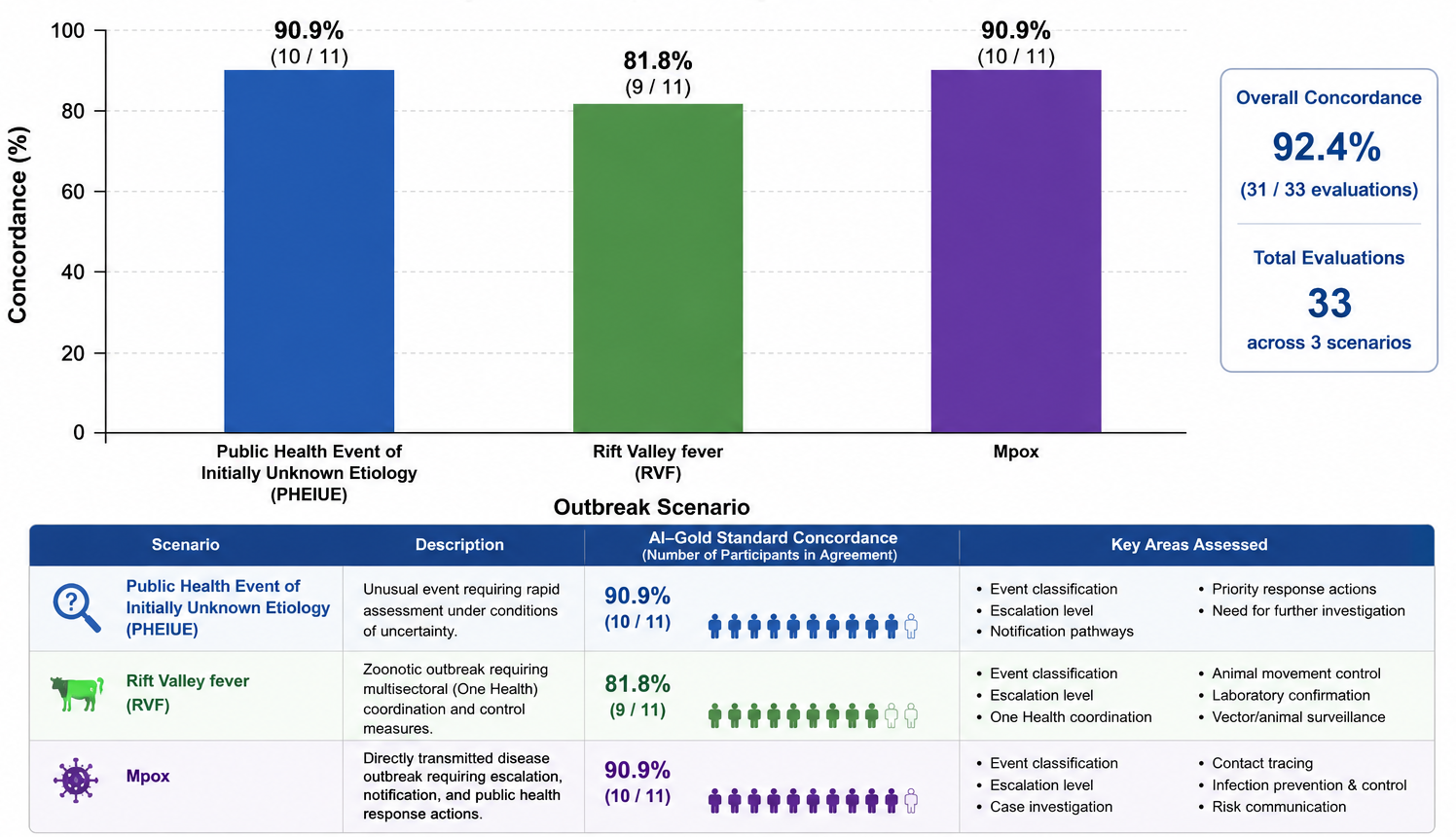
detection remains one of the greatest vulnerabilities in global health security. The outbreak continues to reveal how surveillance gaps, delayed laboratory confirmation, incomplete contact tracing, and fThe evaluation was designed under the coordination of Dr. Eric Osoro, Medical Epidemiologist at Washington State University, who led the overall evaluation methodology. James Magige, Data Intelligence and Monitoring Lead at the Center for Global Health and Pandemic Intelligence, supported the development of the evaluation instruments and assessment tools, while Dr. Samuel Kadivane of KNPHI provided technical oversight for implementation. Researchers from CGHE, CGP, WSU, KIPRE, and KNPHI collaboratively conducted the pilot evaluation, reflecting the consortium’s multidisciplinary approach to ensuring the scientific rigor and operational relevance of the AI Agent.
For Dr. Geoffrey Siwo, the significance of the findings lies in how the technology is being applied.
“What makes this initiative unique is that we are not asking artificial intelligence to make public health decisions, we are asking it to consistently apply a nationally validated public health framework in a transparent and reliable way. That distinction is critical because it keeps human expertise at the centre while enabling AI to enhance the speed, consistency, and scalability of decision support.” said Dr. Siwo
The evaluation demonstrated not only the technical feasibility of the platform but also its potential to support public health emergency operations in a manner that complements existing systems and processes.nd not only on faster response, but on earlier detection.
Lessons from the Ebola Outbreak
The recent Ebola outbreak in East Africa demonstrated exactly why those first hours after an alert are so critical. The earliest warning signs rarely arrive as complete evidence—they emerge as fragments of information that must be interpreted quickly and translated into decisive public health action. The speed and consistency with which those early signals are assessed can determine whether an outbreak is contained locally or evolves into a wider public health emergency.
These are precisely the operational decisions that the DMT-PHE was designed to support. By providing a structured and nationally validated framework for risk assessment, event classification, and escalation, the DMT-PHE helps ensure that critical decisions are made consistently, transparently, and in accordance with established public health emergency management principles. The DMT-PHE AI Agent builds on this foundation by enabling the same decision logic to be applied rapidly and consistently across a wide range of outbreak scenarios, helping bridge the gap between early detection and timely action.
Beyond its technological innovation, the DMT-PHE AI Agent represents the strength of multidisciplinary collaboration. The initiative brought together expertise in public health emergency management, infectious disease epidemiology, artificial intelligence, implementation science, One Health, digital health, and epidemic intelligence from government, academia, and implementation partners. It demonstrates how nationally led innovation, strengthened through strategic partnerships, can produce practical solutions that are both scientifically rigorous and operationally relevant.
The Future of Epidemic Intelligence
Looking ahead, the team sees the DMT-PHE AI Agent as part of a broader effort to strengthen not only emergency response, but also early warning, anticipatory decision-making, and epidemic intelligence in an increasingly complex risk environment.
“The real innovation is not artificial intelligence itself,” reflects Dr. Nanyingi. “It is the combination of public health expertise, operational experience, and technology working together to help decision-makers act faster and more confidently when lives are at stake.”
Dr. Joseph Kamau, Global Health and One Health lead at the Kenya Institute of Primate Research and affiliate of CGHE believes the platform also offers important lessons for future preparedness efforts grounded in the One Health approach.
“Future pandemics are likely to emerge where human, animal, and environmental health intersect. The DMT-PHE AI Agent demonstrates how innovation can operationalize the One Health approach by integrating information across sectors to support earlier risk assessment and timely action”. said Dr. Kamau.
As emerging infectious diseases, zoonotic threats, climate-sensitive health risks, and other public health emergencies continue to challenge health systems around the world, the need for timely predictive, and informed decision-making will only grow. By linking surveillance signals, contextual risk information, and structured escalation logic, the DMT-PHE AI Agent has the potential to serve not only as a response-support tool, but also as an early disease warning and decision-support platform. In this way, it can help public health teams move from detecting signals to anticipating risks, prioritizing action, and triggering timely preparedness and response measures.
Ultimately, the vision behind the DMT-PHE AI Agent is to ensure that when the next public health threat emerges, decision-makers are equipped not only to respond rapidly but to recognize risks earlier, anticipate escalation, and act before outbreaks become crises.