The First 100 Days: Why the DRC Ebola Epidemic is still accelerating

From Detection to Decision: How Kenya is Transforming Public Health Emergency Response with Artificial Intelligence
July 21, 2026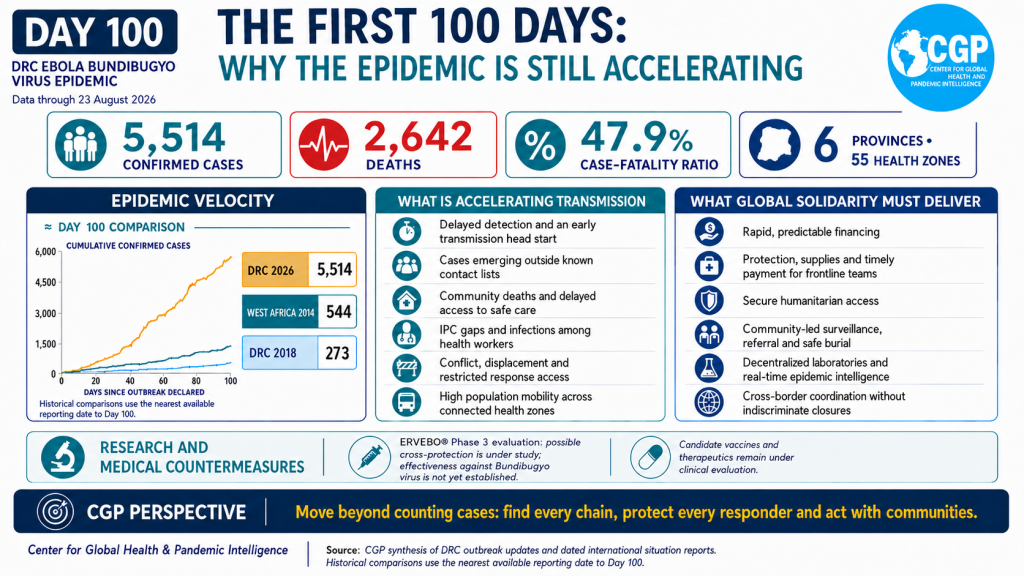
CGP Global Health Security Brief | Nairobi-Kenya| Aug 26 2026- 18:00 EAT
The epidemic will not slow because the world expects it to. It will slow only when every alert is investigated, every patient can access safe care, every contact is followed and every affected community becomes a trusted partner in the response.– Prof Mark Nanyingi, Global Health and Infectious Diseases Epidemiologist
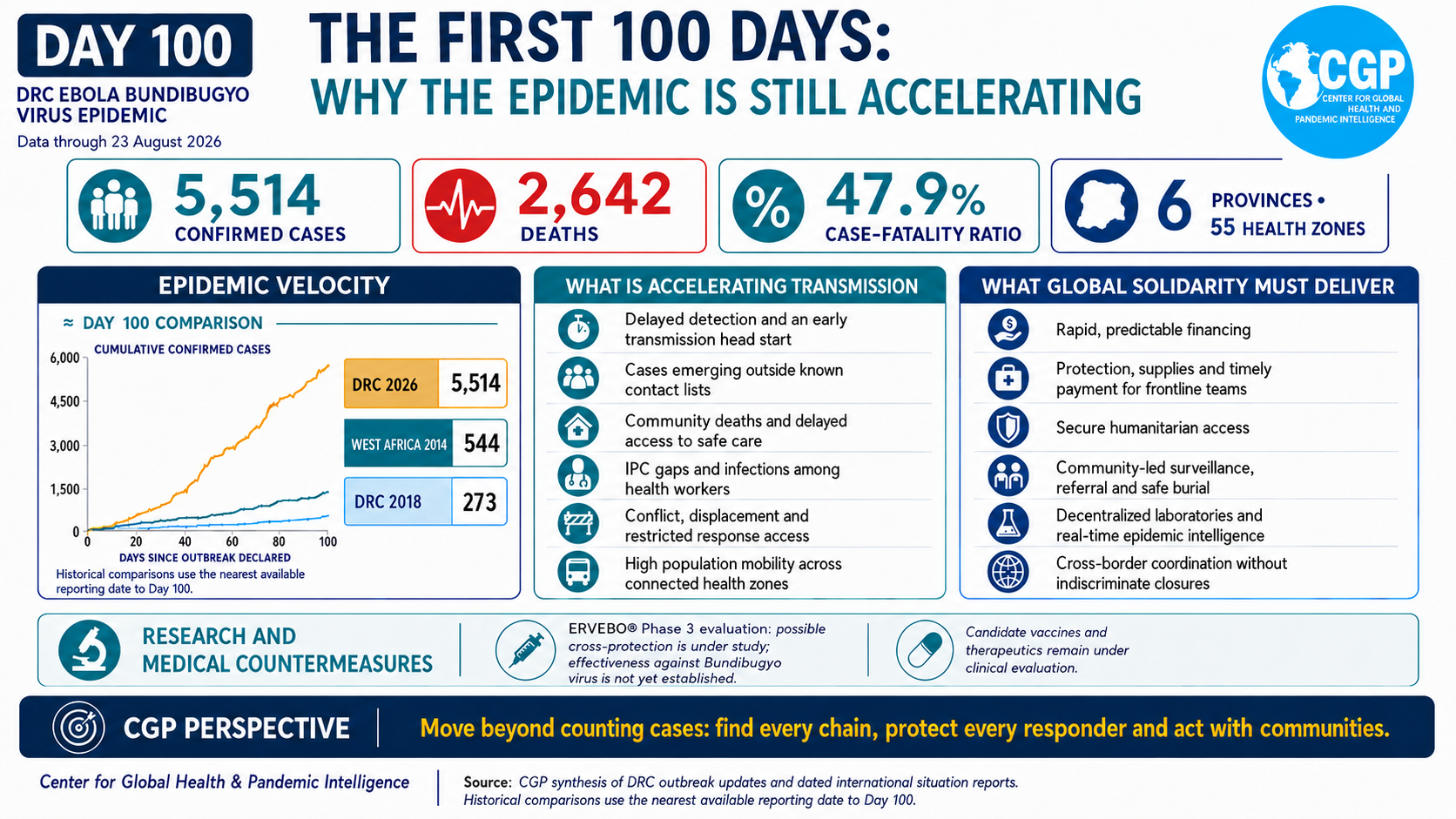
One hundred days after the Democratic Republic of the Congo declared an outbreak of Bundibugyo virus disease on 15 May 2026, the epidemic is still spreading. It is expanding geographically, overwhelming parts of the health system and exposing persistent weaknesses in the world’s ability to contain outbreaks in fragile and conflict-affected settings. By the end of the first 100 days, approximately 5,514 confirmed cases and 2,642 deaths had been reported, representing a case-fatality ratio of nearly 48%. The epidemic has already exceeded the DRC’s 2018–2020 outbreak, which recorded 3,317 confirmed cases over almost two years. This has become the largest recorded Ebola outbreak in the DRC and is expanding faster than previous outbreaks in the country. It however remains smaller compared to the 2013–2016 West African epidemic, but its early trajectory is deeply concerning.
A steep and sustained Epidemic curve
The progression has been extraordinary. Confirmed cases increased from 85 on 21 May to 515 by 6 June, 1,460 by 1 July, 3,605 by 30 July and more than 5,500 by the end of the first 100 days.Some of this increase reflects expanded laboratory testing, the clearance of sample backlogs and improvements in surveillance. These measures have revealed infections that were previously undetected. However, most of the increase represents genuine epidemic expansion, with sustained transmission across interconnected geographic clusters.There is currently no published evidence that the virus has acquired substantially greater intrinsic transmissibility. The more scientifically plausible explanation is that a virus with known transmission characteristics is exploiting an exceptionally permissive and fragmented social -operational environment. Ebola control depends on detecting infected people quickly, isolating and treating them safely, identifying their contacts and preventing further exposure. When delays accumulate at each stage, transmission chains multiply faster than response teams can identify and interrupt them.
Why is the rapid transmission continuing?
The outbreak had a substantial head start: The first known patient developed symptoms on 24 April, several weeks before the outbreak was confirmed. Available epidemiological evidence suggests that transmission may have begun even earlier. Delayed recognition allowed the virus to spread through households, health facilities and communities before an Ebola-specific response was fully activated. By the time confirmation occurred, response teams were confronting multiple transmission chains rather than a single, geographically contained cluster.
Too many cases remain outside known contact lists: A significant proportion of new patients continue to be detected without having previously been identified as contacts. This means surveillance systems are identifying only part of the transmission network.Contact follow-up has improved to more than 80%, but it remains below the operational level required to identify and monitor nearly all exposed individuals. Missed contacts can become symptomatic, travel between communities and expose caregivers before health authorities know they exist.Every unlinked case is therefore more than a statistical gap. It is evidence of a transmission chain that has not yet been found.
Community deaths are sustaining hidden transmission: Many patients are still dying at home, outside treatment centres and outside established contact lists. People with advanced Ebola disease carry high viral loads, while home-based caregiving and some funeral practices may involve direct contact with infectious body fluids.A community death can therefore represent several missed opportunities: failure to detect the illness, failure to refer the patient, failure to protect caregivers and failure to identify exposed contacts. High mortality is both a consequence of the epidemic and a condition that can sustain further transmission.
Health facilities remain vulnerable: Infections and deaths among health workers indicate continuing weaknesses in screening, triage, isolation, personal protective equipment (PPE), environmental hygiene and occupational exposure management.When health workers become infected, the effect extends beyond the individual cases. Facilities lose essential personnel, remaining workers experience fear and exhaustion, and communities may avoid seeking treatment. Reduced confidence in health facilities can drive more patients to remain at home, further delaying diagnosis and isolation.Disruption of routine services also increases deaths from malaria, maternal complications, childhood illnesses and other conditions. The wider health-system impact may therefore be considerably greater than the reported Ebola burden.
Conflict and displacement are fragmenting the response: The epicentre overlaps with areas affected by armed conflict, attacks on civilians and health facilities, population displacement and restricted humanitarian access.Insecurity interrupts contact tracing, closes facilities and prevents response teams from reaching some communities. It also forces people to move between settlements, displacement camps, mining areas and border regions.A contact monitored today may be displaced tomorrow. A specimen may be collected but not transported promptly. A response team may be ready but unable to enter an affected community safely. These interruptions create the operational space in which transmission persists.
Mobility is connecting local transmission clusters: Eastern DRC contains highly mobile mining populations, commercial routes, border crossings, displacement settlements and inland waterways connecting rural communities with major urban centres.Mobility does not cause Ebola transmission. However, when infected or exposed people travel while surveillance remains incomplete, previously separate transmission clusters become epidemiologically connected.The spread across dozens of health zones and six provinces illustrates how quickly a series of local containment failures can become a national and regional emergency.
Medical countermeasures remain limited: The epidemic is caused by Bundibugyo virus, for which no specifically approved vaccine or therapeutic treatment is currently available. Candidate vaccines and therapeutics are being evaluated, but their availability and effectiveness cannot yet be assumed.Vaccines and therapeutics may strengthen control, but they cannot replace the fundamental work of identifying and interrupting every transmission chain. An ongoing Phase 3 trial is assessing whether Ervebo, a vaccine licensed against Zaire ebolavirus, provides meaningful cross-protection against Bundibugyo virus. Although preclinical evidence supports its evaluation, effectiveness against the current outbreak strain has not yet been established. The trial is therefore an important scientific opportunity, but Ervebo should not be presented as a proven Bundibugyo vaccine until robust clinical results are available.

Lessons from previous outbreaks
The West African epidemic demonstrated the consequences of delayed international mobilisation, fragmented coordination and health systems that lacked the capacity to detect and manage rapidly expanding transmission.It also demonstrated that epidemic trajectories can be reversed. Transmission declined when communities, frontline services, laboratories, treatment centres and emergency coordination structures began operating as one connected system.The 2018–2020 epidemic in eastern DRC provided another critical lesson: community trust is not an optional communication activity. It is a core epidemiological intervention.
Contact tracing, early referral, safe burial and vaccination cannot succeed when communities perceive response measures as externally imposed, coercive or disconnected from their immediate needs. Trust influences whether symptoms are reported, contacts cooperate, families accept referral and communities permit response teams to operate.Uganda’s interruption of transmission following imported cases during the current epidemic provides a further lesson. Strong preparedness systems, rapid detection, decisive leadership and community cooperation can prevent imported infections from developing into sustained community transmission.
What Global Health Solidarity must deliver
Global solidarity must move beyond declarations of concern and translate into measurable operational capacity.The DRC requires predictable and rapidly accessible financing under a single government-led response framework. Frontline personnel must be trained, protected, equipped and paid on time. Delayed salaries, inadequate protection and exhausted teams directly weaken surveillance, clinical care and community confidence.
Humanitarian, security and public-health actors must establish protected access arrangements so that surveillance, laboratory, clinical and burial teams can reach affected communities without repeated interruption.Laboratory capacity and epidemic intelligence must also be decentralised. Alerts should be investigated rapidly, specimens transported and tested without avoidable delay, and epidemiological data used to map contacts, mobility patterns and hidden transmission chains. Communities must become co-designers of the response. Religious leaders, traditional authorities, survivors, community health workers and local civil-society organisations should help determine how alerts are reported, patients are referred, contacts are followed and burials are conducted. Families affected by isolation or movement measures should receive food, water, psychosocial assistance and appropriate financial support.
Neighbouring countries require funded operational readiness rather than indiscriminate border closures. Cross-border surveillance, interoperable contact-monitoring systems, trained rapid-response teams and pre-positioned supplies are more effective than restrictions that may redirect travellers towards informal crossings. Clinical research must also proceed at emergency speed while maintaining scientific rigour, ethical oversight, community participation and equitable access. Communities contributing to vaccine and therapeutic trials must not be the last to benefit from successful products.
What happens in the next 100 Days
The next 100 days must be defined by speed, trust and shared responsibility. Ebola exploits gaps between communities and institutions, between health zones and borders, and between international commitments and resources delivered. Global health solidarity can close those gaps not by replacing national leadership, but by providing the financing, technical capacity, technologies, operational access and equitable partnerships required for that leadership to succeed.
Technical sources: DRC Ministry of Public Health outbreak updates; Africa CDC situation reports; WHO disease-outbreak notices and temporary recommendations; and published evidence from previous Ebola responses.