Leveraging One Health to Strengthen Pandemic Preparedness in Kenya

Kenya advances One Health and Pandemic Preparedness with Launch of Rift Valley Fever Contingency Plan and Human Brucellosis Testing Guidelines
November 5, 2025
Africa’s Pandemic Preparedness Strengthened through a USD 80M Harmonised One Health Initiative
November 27, 2025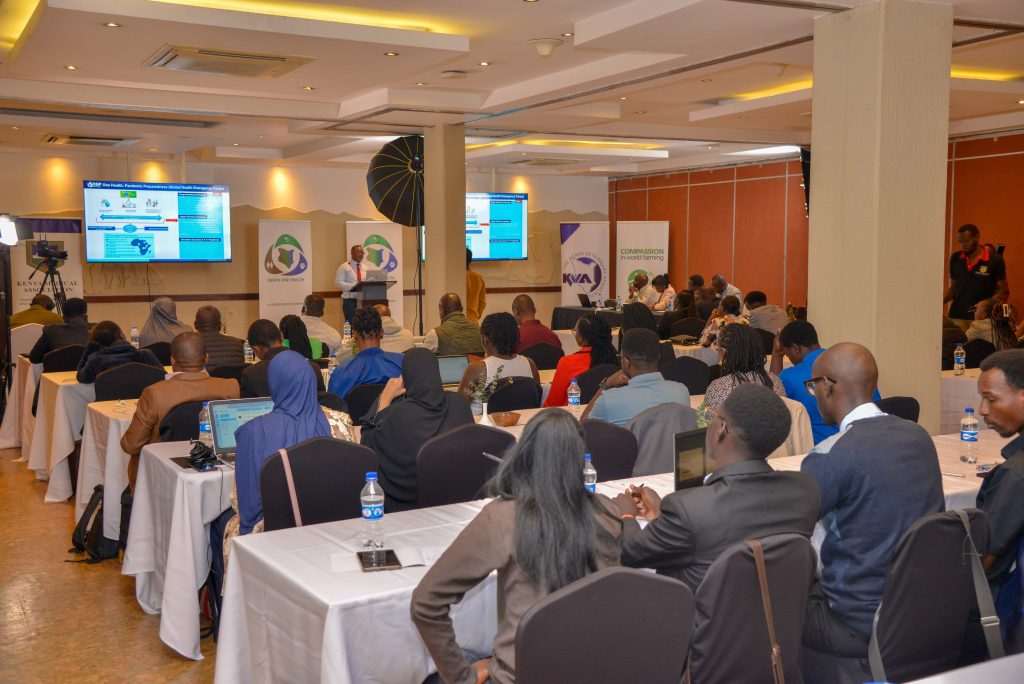
November 9, 2025- Nairobi
At the inaugural Kenya One Health Conference (KOH 2025) jointly organized by the Kenya Medical Association (KMA) and Kenya Veterinary Association (KVA) under the global theme “By Protecting One, We Help Protect All”. CGP’s Technical Director for Global Health Security, Dr. Mark Nanyingi, delivered the opening keynote address on “Leveraging One Health to Strengthen Pandemic Preparedness in Kenya.”
Speaking before over 200 distinguished delegates drawn from human medicine, veterinary medicine, public health, environmental health, research, and academia, Dr. Nanyingi traced Kenya’s journey from responding to zoonotic outbreaks to building integrated systems for pandemic prevention, preparedness, and resilience. “Pandemic preparedness begins long before the next outbreak—it begins with how we choose to collaborate today.” Dr. Nanyingi
Pandemic Horizons, Pathways for Infectious Diseases Emergence and Re-emergence?
He outlined the global and national landscape of emerging and re-emerging infectious diseases, noting that “over 80 percent of all emerging pathogens are zoonotic in origin.” using recurrent outbreaks such as Rift Valley Fever, Brucellosis, Anthrax, Rabies, Marburg, and Mpox that continue to test the resilience of Kenya’s surveillance and response mechanisms. Global maps of epidemic hotspots indicate that Kenya sits at a convergence zone for vector-borne and spillover risks due to climate variability, land-use change, and human–animal interface. “Zoonotic threats are not random events they are predictable outcomes of how humans interact with animals and ecosystems. Preparedness therefore requires integrated thinking, not isolated action.
Operationalization and Institutionalization of One Health
Kenya has systematically embedded One Health in national and subnational systems over the past three decades.
Key milestones included:
- Institutional coordination through the Zoonotic Disease Unit (ZDU) and establishment of County One Health Units (COHUs) linking human, animal, and environmental health actors.
- Development of disease-specific contingency plans and national strategies for Rabies (2014), Anthrax (2021), Brucellosis (2021), and Antimicrobial Resistance (2023).
- Integration of Joint Risk Assessments (JRA), risk communication, and multisectoral coordination into the IHR–PVS National Roadmap and MCM Action Plans.
“What began as an intersectoral concept has now matured into a governance framework. The challenge is no longer ‘why One Health’ but ‘how effectively we institutionalize and sustain it’.”
Decision Intelligence and the 7-1-7 Paradigm
The introduction of Kenya’s Decision-Making Tool for Public Health Emergencies (DMT-PHE) an innovation developed by CGP in collaboration with the Kenya National Public Health Institute (KNPHI) and Ministry of Health is a game-changer.The tool standardizes escalation, coordination, and support from community to county to national level, ensuring that event detection, notification, and response meet the 7-1-7 target (detect within 7 days, notify within 1 day, respond within 7 days). Using case studies of Rift Valley Fever (Wajir, Marsabit 2024) and Mpox (2024) he illustrated “One Health in Action” where One Health mechanisms were jointly applied to guide rapid, evidence-based decisions and the potential to use DMT-PHE in future outbreaks.
The DMT-PHE is Kenya’s decision intelligence backbone transforming alerts into action, and coordination into accountability.” DMT-PHE aligns with WHO’s Emergency Response Framework, IHR Annex 2, and Africa CDC’s 7-1-7 performance metrics, positioning Kenya as a continental model for operational readiness.
Integrating Systems: From Data to Action
The importance of data integration and digital transformation in pandemic preparedness cannot be overemphasised. Kenya has made strides in linking the Integrated Disease Surveillance and Response (IDSR) platform, Event-Based Surveillance (EBS), Kenya Animal Biosurveillance System (KABS), and Public Health Emergency Management (PHEM) functions. A digitized DMT-PHE will provide real-time dashboards for early warning, cross-sector data sharing, and decision analytics connecting surveillance to action at both county and national levels. “We must move from spreadsheets to situation rooms — where data flows seamlessly across human, animal, and environmental health systems.”
Investing in Health Emergency Workforce
Kenya’s One Health workforce development ecosystem, aims to be transformative in response to outbreaks, some of the multidiscplinary inititatives includes:
- Field Epidemiology and Laboratory Training Program (FELTP)– builds the front line of evidence-based action turning surveillance data into decisions that save lives
- In-Service Applied Veterinary Epidemiology Training (ISAVET) and AFROHUN (Africa One Health University Network) – next generation of animal and human health professionals through joint learning and field experience building a culture of collaboration from the classroom to the community
- AVOHC SURGE – embodies Africa’s collective readiness- a trained corps standing ready to move across borders at short notice to contain health threats before they spread.
There is urgent need for multidisciplinary training and certification, linking Kenya’s workforce registry with the forthcoming Global Health Emergency Corps (GHEC) to enable rapid deployment and continuous professional development. “Our greatest defense against pandemics is not a stockpile — it is a skilled, networked, and digitally empowered workforce.”
Pandemic Treaty and IHR Amendments
Turning to the international stage, the ongoing WHO Pandemic Agreement and amendments to the International Health Regulations (2005) are pivotal reforms for global health equity. Kenya’s advocacy for revision of a multilateral access and benefit-sharing system for pathogens with pandemic potential, the Pathogen Access and Benefit-Sharing System (PABS System), which will enhance equitable access to vaccines, diagnostics, and therapeutics. Kenya has also made tremendous efforts in resource mobilization for sustainable financing of IHR core capacities through mechanisms such as the Pandemic Fund and the Global Fund. “The Pandemic Treaty represents a once-in-a-generation opportunity to hardwire equity, accountability, and One Health principles into global governance.”
The policymakers should leverage these reforms to accelerate local manufacturing (BioVax), strengthen genomic surveillance hubs, and institutionalize KNPHI as Kenya’s national IHR authority.
Looking ahead, From Silos to Synergy
Dr. Nanyingi called for a future anchored on collaboration, innovation, and sustainability and outlined four imperatives for the next decade:
- Integrate One Health fully into Kenya’s national pandemic preparedness architecture.
- Invest in data systems, digital tools, and sustainable financing models.
- Inspire communities through risk communication, behavioural change, and local ownership.
- Innovate using AI-driven epidemic forecasting and climate-informed early warning.
“Preparedness is not built in the heat of crisis, it’s cultivated through partnership, foresight, and trust.”